

Joseph Mallord William Turner, Self-Portrait c.1799. Tate.
See some of Turner’s major works that helped change the course of British painting over his fifty-year career
These central rooms show works Turner painted for exhibitions or other displays. Many were first seen at the Royal Academy, where from 1790 to 1850 he exhibited almost every year, presenting a wide variety of subjects and constantly evolving his style. While collectors and critics flocked to the Academy, on Varnishing Days, when pictures were finished before the exhibition opened, he upstaged artist colleagues with his technical virtuosity.
In the 1790s the Academy promoted the Grand Style, epitomised by classical or biblical narratives by painters like Titian, Poussin, Rembrandt or Claude Lorrain. Turner’s early exhibits were often homages to the Old Masters. Some were even commissioned as pendants to them. Over time, their influence yielded to his own unique creative imagination, expressive handling and mastery of light and colour. Outstripping contemporary taste, his later exhibited pictures mystified conservative critics.
As well as the Academy, Turner sometimes showed at the rival British Institution. From 1804, Turner’s Gallery displayed more personal or experimental work as well as pictures unsold or reserved for his bequest.His paintings and watercolours could also be seen in the private houses and galleries of patrons and collectors. Occasionally, he exhibited abroad.
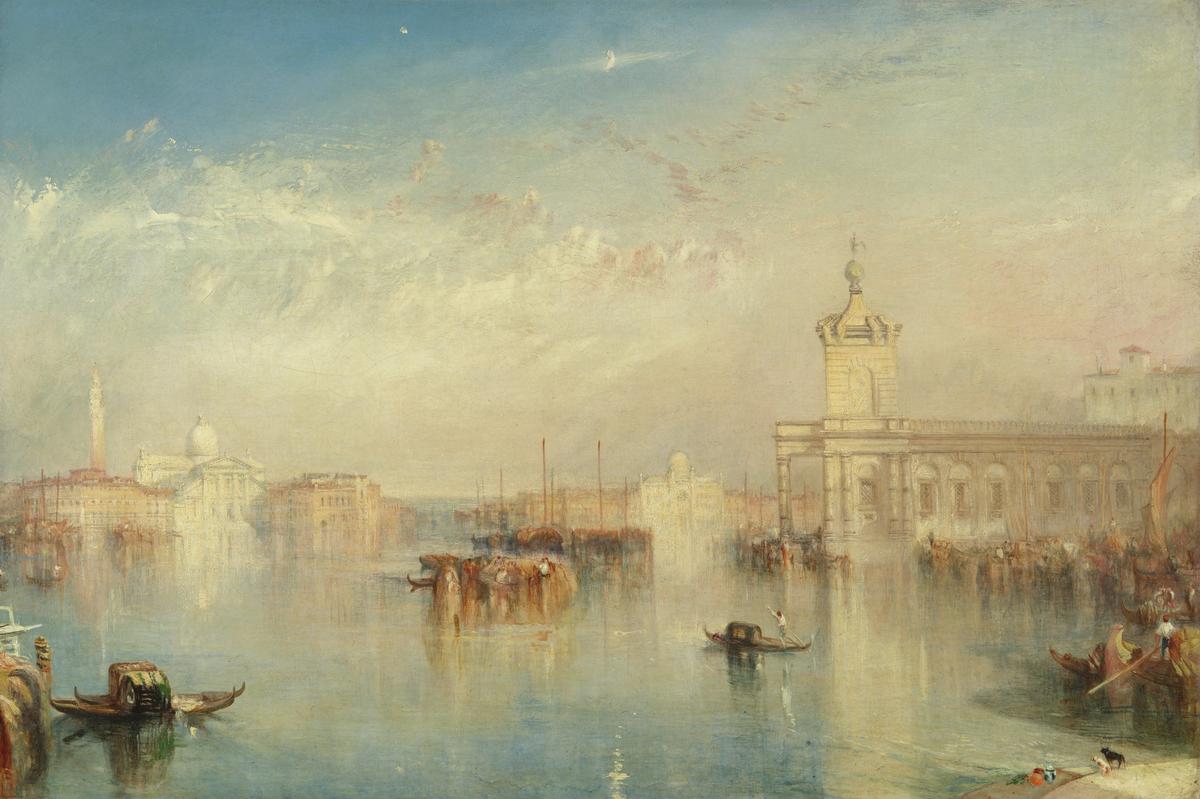
Joseph Mallord William Turner, The Dogana, San Giorgio, Citella, from the Steps of the Europa exhibited 1842
Gallery label, August 2024
1/9
artworks in Turner Exhibited: Ambition and Reputation
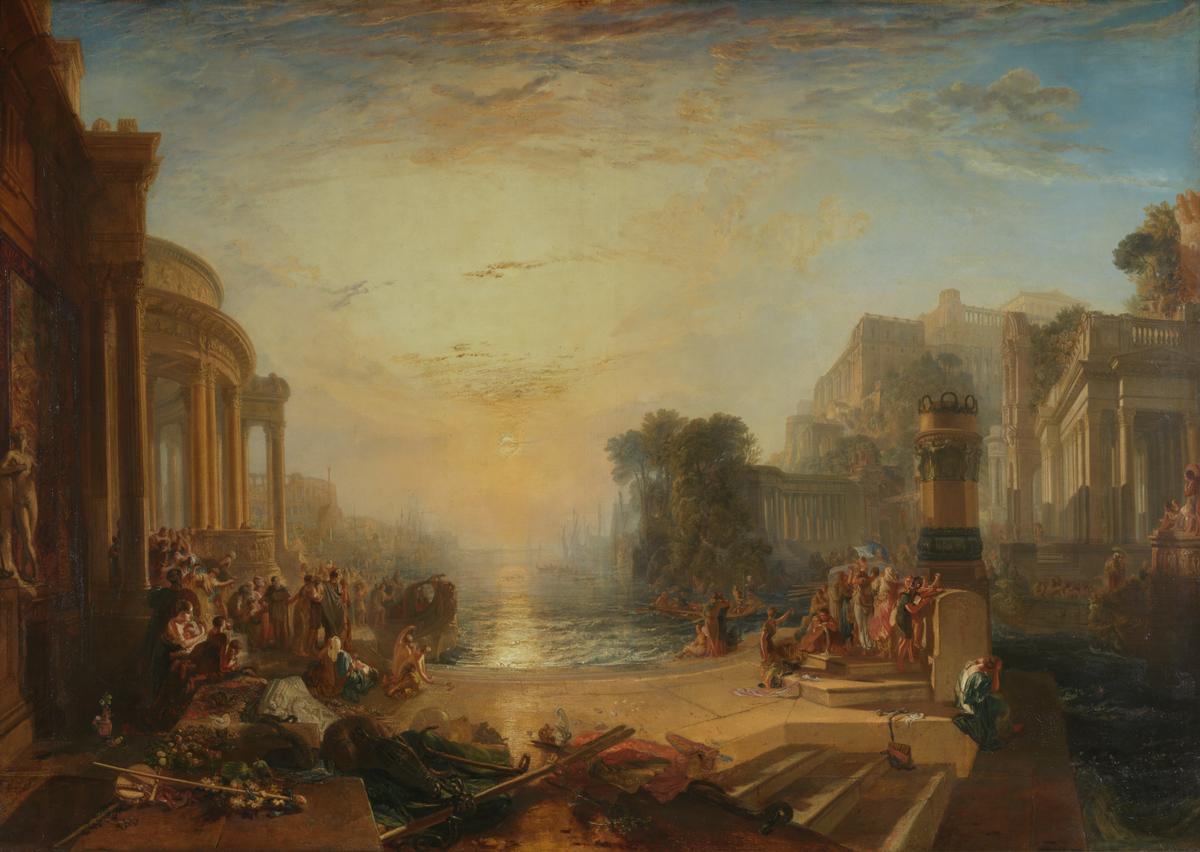
Joseph Mallord William Turner, The Decline of the Carthaginian Empire ... exhibited 1817
Exhibited two years after France’s defeat at Waterloo by British and allied forces, this luminous harbour scene would have been understood as a reflection of contemporary European politics. It shows the sun setting on Carthage, North Africa, the centre of the most powerful empire until the rise of ancient Rome. Turner compares warring Rome and Carthage to the rival empires of Britain and France. The scene is inspired by the work of 17th-century painter Claude Lorrain (known as Claude). Its pair, showing the sun rising on the Carthaginian Empire, hangs alongside a painting by Claude in the National Gallery, as Turner requested in his will.
Gallery label, October 2023
2/9
artworks in Turner Exhibited: Ambition and Reputation
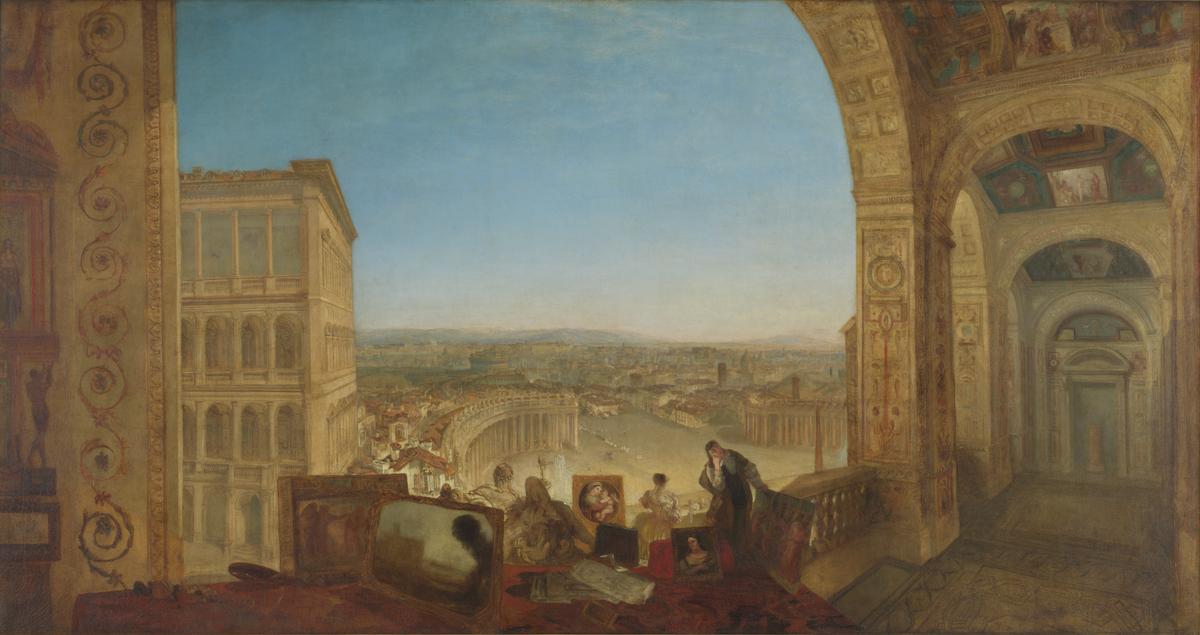
Joseph Mallord William Turner, Rome, from the Vatican. Raffaelle, Accompanied by La Fornarina, Preparing his Pictures for the Decoration of the Loggia exhibited 1820
Turner revelled in the history, architecture and light of Rome. On his return, he painted this sweeping view from the Vatican. It was Turner’s tribute to Italian Renaissance painter and architect Raphael, which he exhibited on the 300th anniversary of his death. Raphael stands in the foreground with his companion La Fornarina. He gazes at the overhead vaults of the Loggia, painted by him and his students. The drawings and paintings in the centre foreground represent the breadth of Raphael’s talent.
Gallery label, October 2023
3/9
artworks in Turner Exhibited: Ambition and Reputation
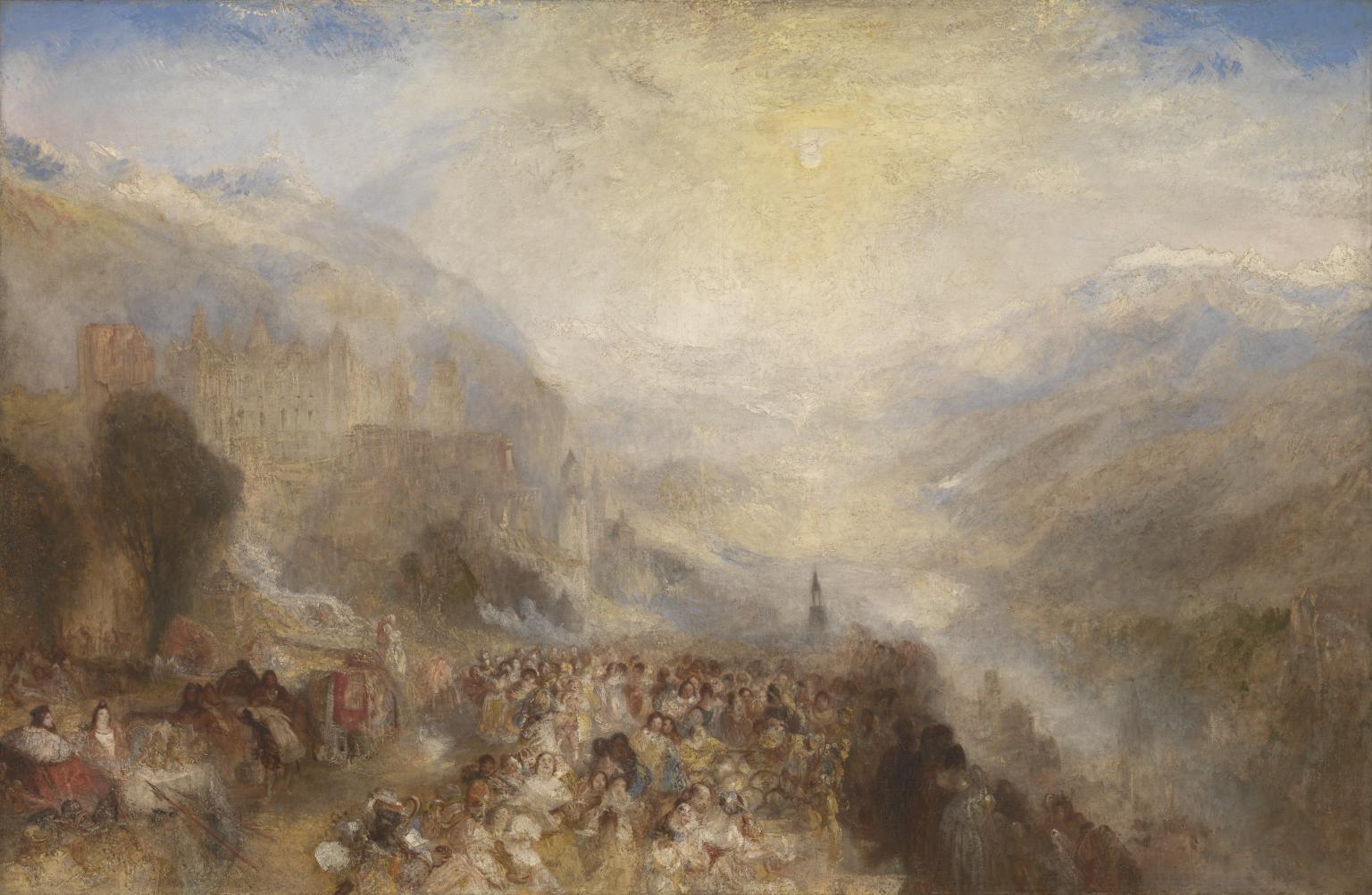
Joseph Mallord William Turner, Castle in an Alpine Valley, called ‘Heidelberg’ c.1844–5
Turner never exhibited this painting and its subject is elusive. Showing a gathering beneath a castle amid snow-capped peaks, it has traditionally been called ‘Heidelberg’ after the German castle that fascinated Turner. Heidelberg was, however, a ruin in Turner’s lifetime. While this painting might imagine Heidelberg in its heyday, the setting does not match. It more closely resembles Alpine scenery. At the bottom left sits a figure in a Renaissance-style fur-collared red robe. He is no doubt the key to the historical narrative but who is he? Research goes on to solve its puzzles.
Gallery label, October 2023
4/9
artworks in Turner Exhibited: Ambition and Reputation
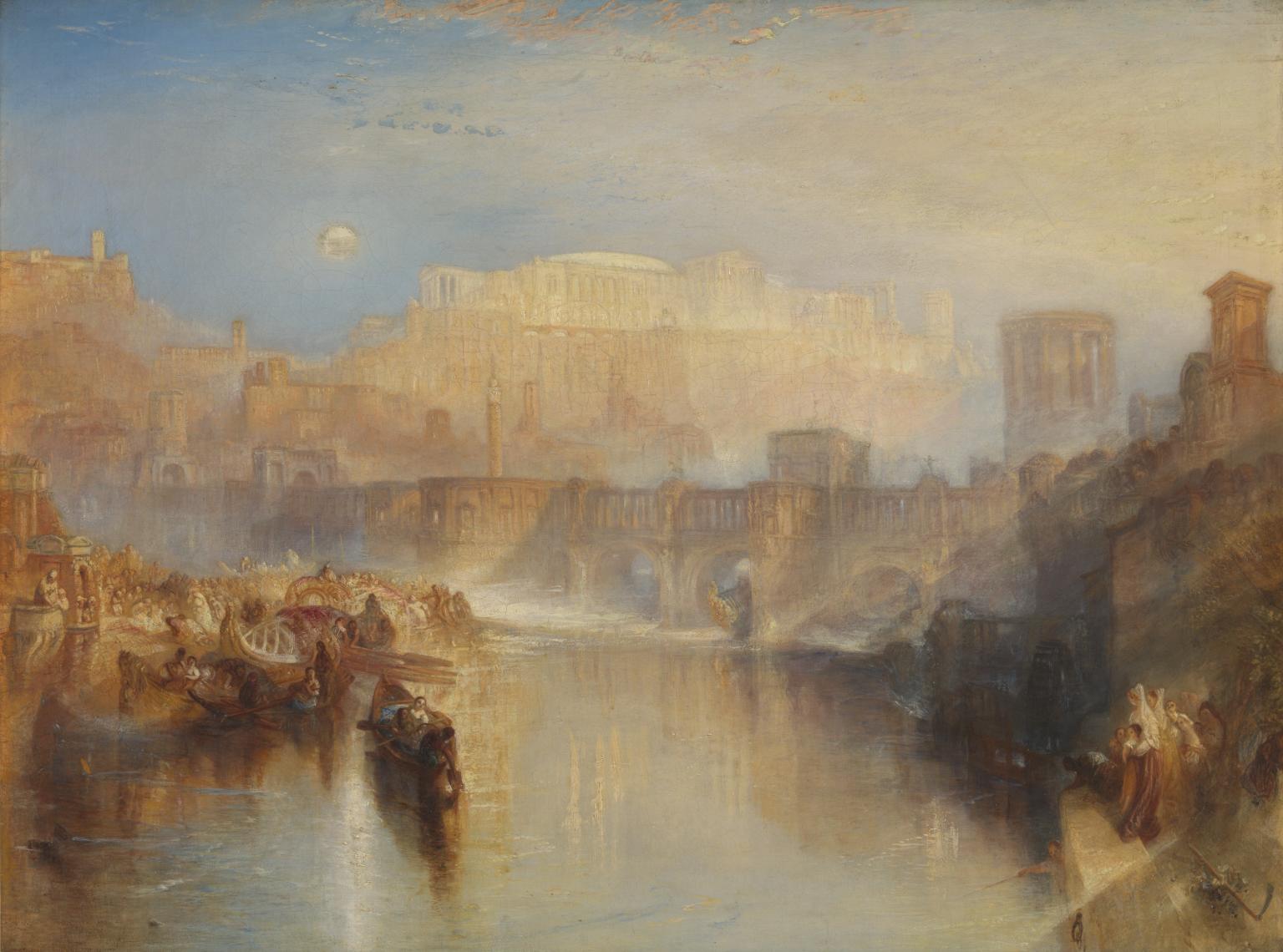
Joseph Mallord William Turner, Ancient Rome; Agrippina Landing with the Ashes of Germanicus exhibited 1839
Turner draws on his observations of Rome and his imagination to depict the city in ancient times. Rising from the mist it appears as a glowing mass of buildings that melts into the distance. Turner overlays this dreamlike cityscape with a story about love and devotion from ancient Italy. Agrippina was married to Roman general, Germanicus. When he was killed, Agrippina carried his ashes back to Rome in an urn. She was met on her journey by crowds of mourners.
Gallery label, October 2023
5/9
artworks in Turner Exhibited: Ambition and Reputation
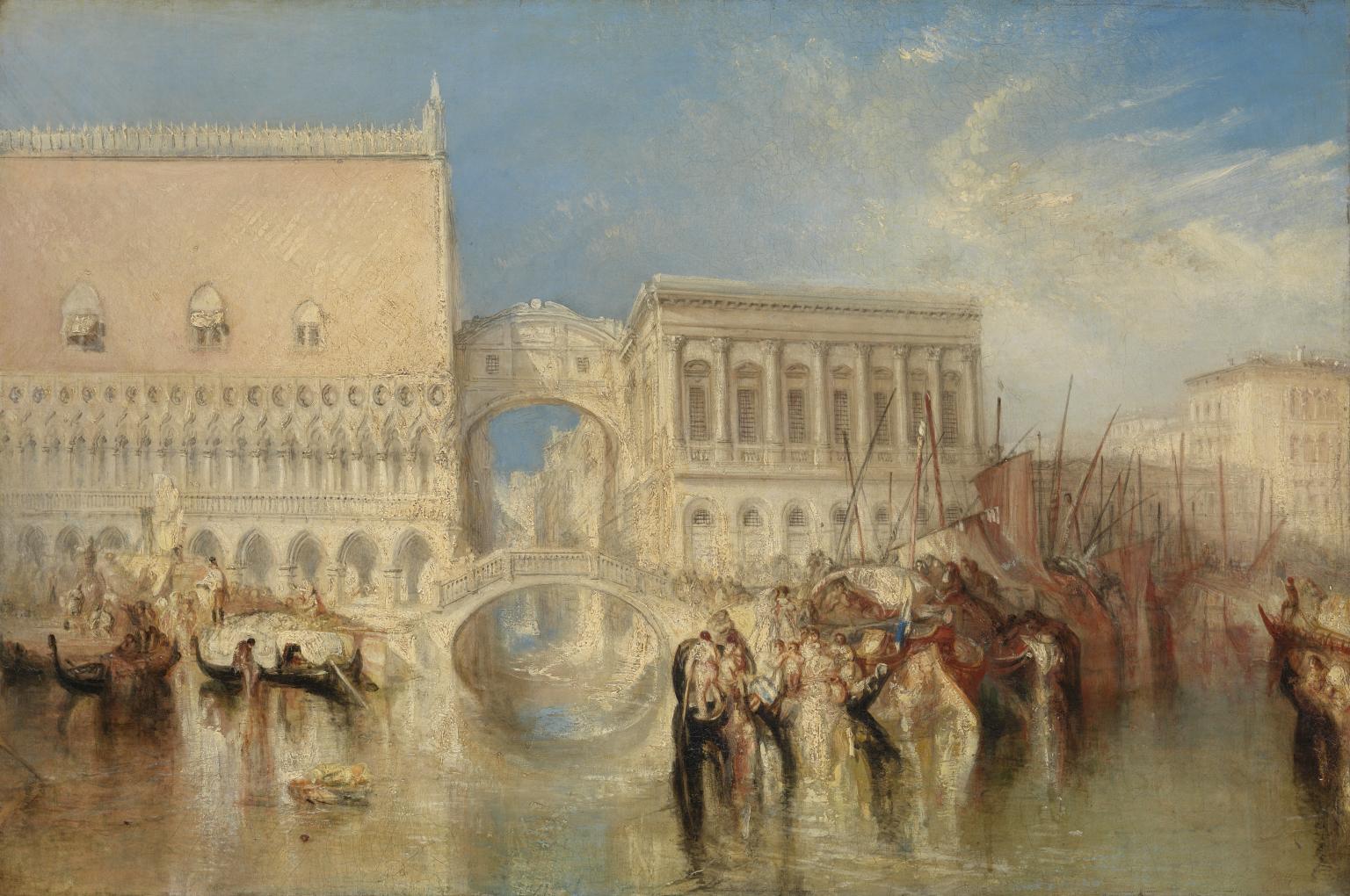
Joseph Mallord William Turner, Venice, the Bridge of Sighs exhibited 1840
Turner painted Venice on smaller canvases with a new kind of customer in mind – the middle-classes. Many of them holidayed in Venice, inspired by Romantic poet Byron, who had lived there. He had written movingly of how this once-splendid republic had lost its independence – taken over by Napoleon in 1797 and then Austria in 1815.This glittering painting shows one of Venice’s most famous sights, the Bridge of Sighs, between the Doge’s Palace and the city’s prison. Turner exhibited it with lines adapted from Byron: ‘I stood upon a bridge, a palace and / A prison on each hand’.
Gallery label, October 2023
6/9
artworks in Turner Exhibited: Ambition and Reputation
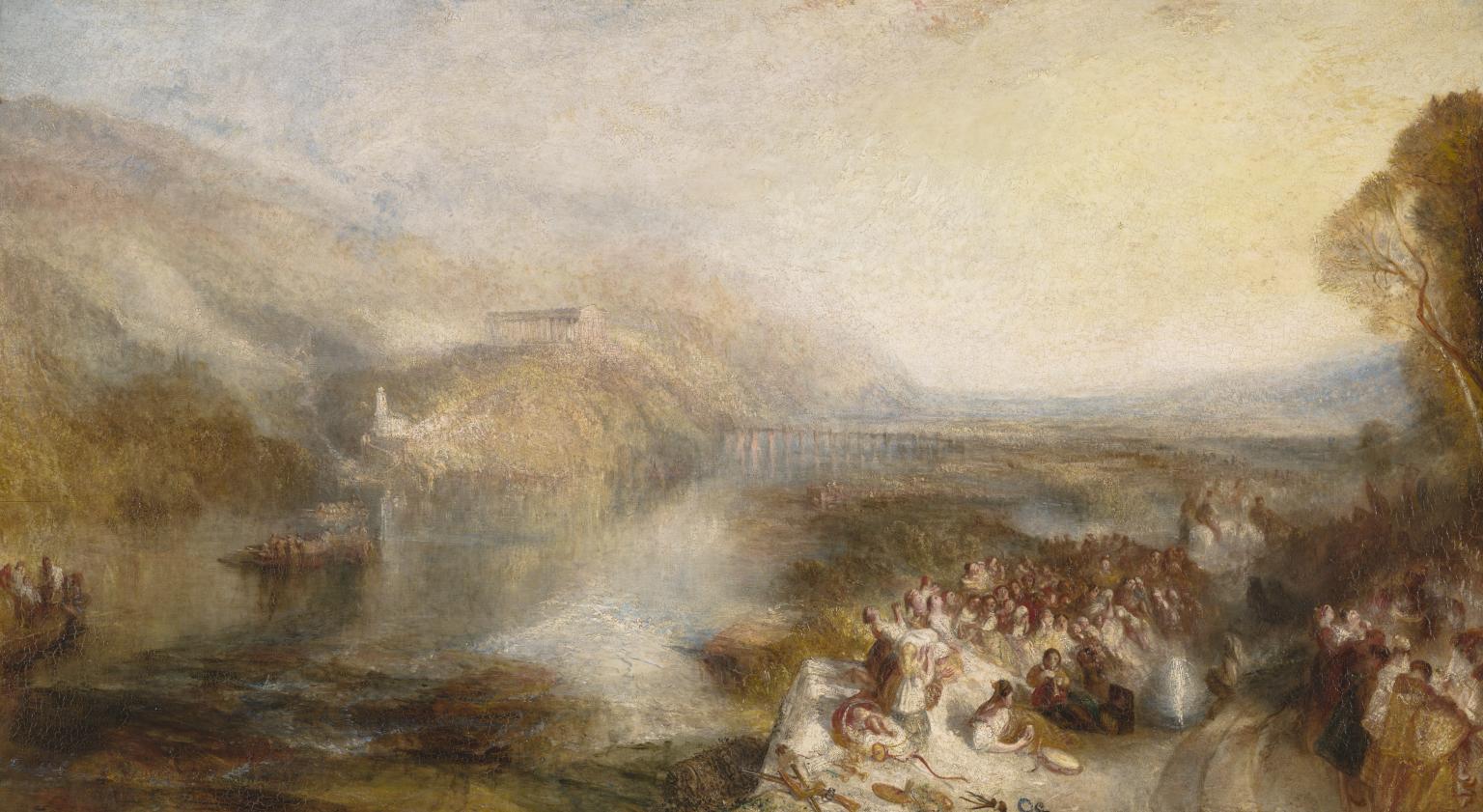
Joseph Mallord William Turner, The Opening of the Wallhalla, 1842 exhibited 1843
Returning from Venice in 1840, Turner saw the nearly completed Walhalla by the River Danube. Set into the hillside, this gigantic monument was built to celebrate German history and culture after the defeat of Napoleon and removal of French rule. Turner imagines its opening, painting in a feast and a procession on horseback in the right-hand foreground. It was shown in London in 1843 and Munich in 1845. Despite Turner’s intent for it to be a tribute, it was taken as an insult because of its hazy atmosphere and lack of precision. When it was returned damaged, Turner reacted like a ‘hen in a fury’.
Gallery label, October 2023
7/9
artworks in Turner Exhibited: Ambition and Reputation
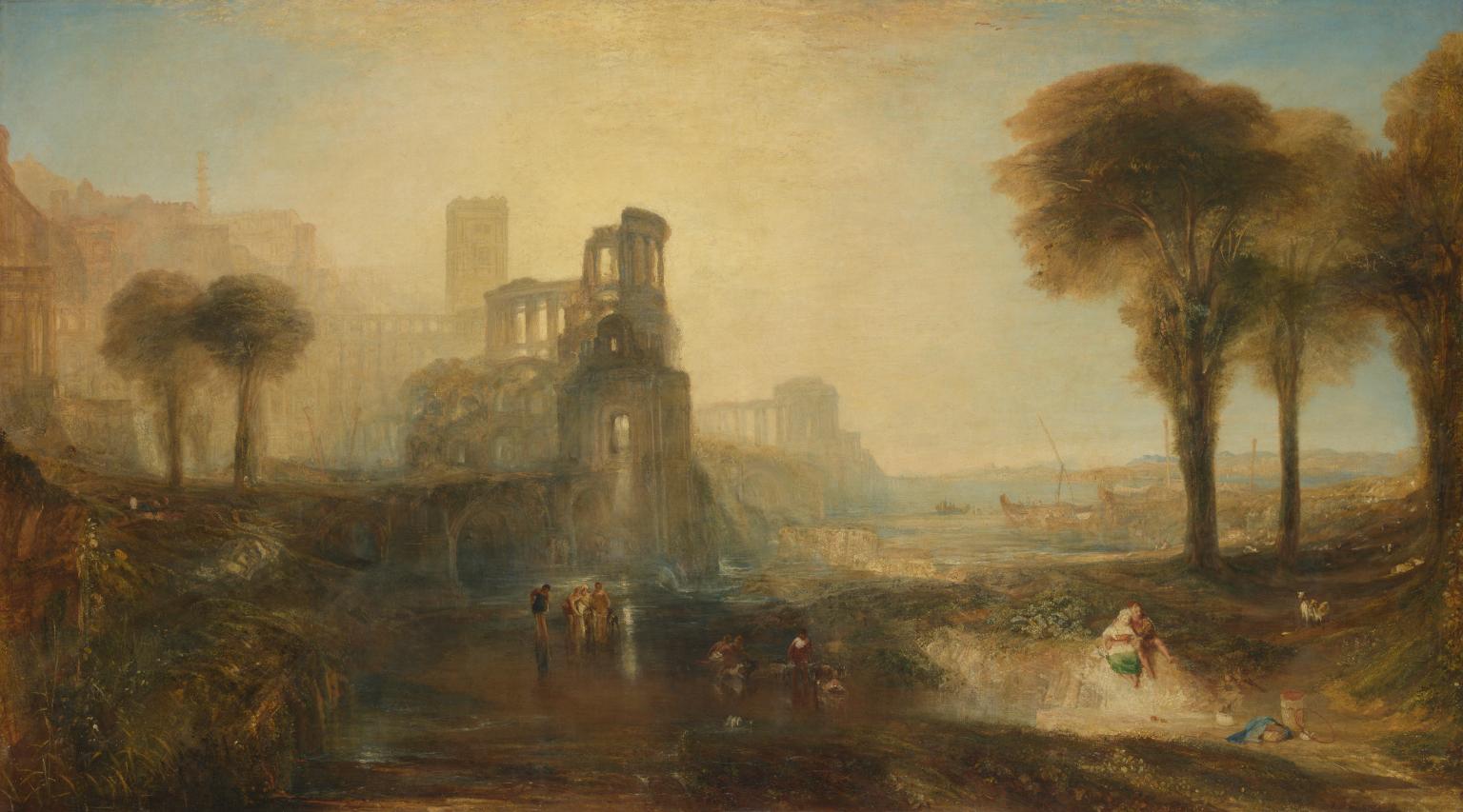
Joseph Mallord William Turner, Caligula’s Palace and Bridge exhibited 1831
Roman Emperor Caligula built a three-milelong floating bridge to prove his brilliance. He crossed his bridge – supposedly made from boats fastened together – on horseback. Turner shows a crumbling, overgrown stone bridge, however, and exhibited this painting with his own poetry that spoke of ‘ruind hopes’. Showing it the year after a wave of revolutions had swept through Europe, its message that the glory of arrogant rulers would fade over time was particularly loaded. Reviewers in 1831 praised its ‘magical’ atmosphere. It hung next to a painting by John Constable, a pairing the critics described as ‘fire and water’.
Gallery label, October 2023
8/9
artworks in Turner Exhibited: Ambition and Reputation
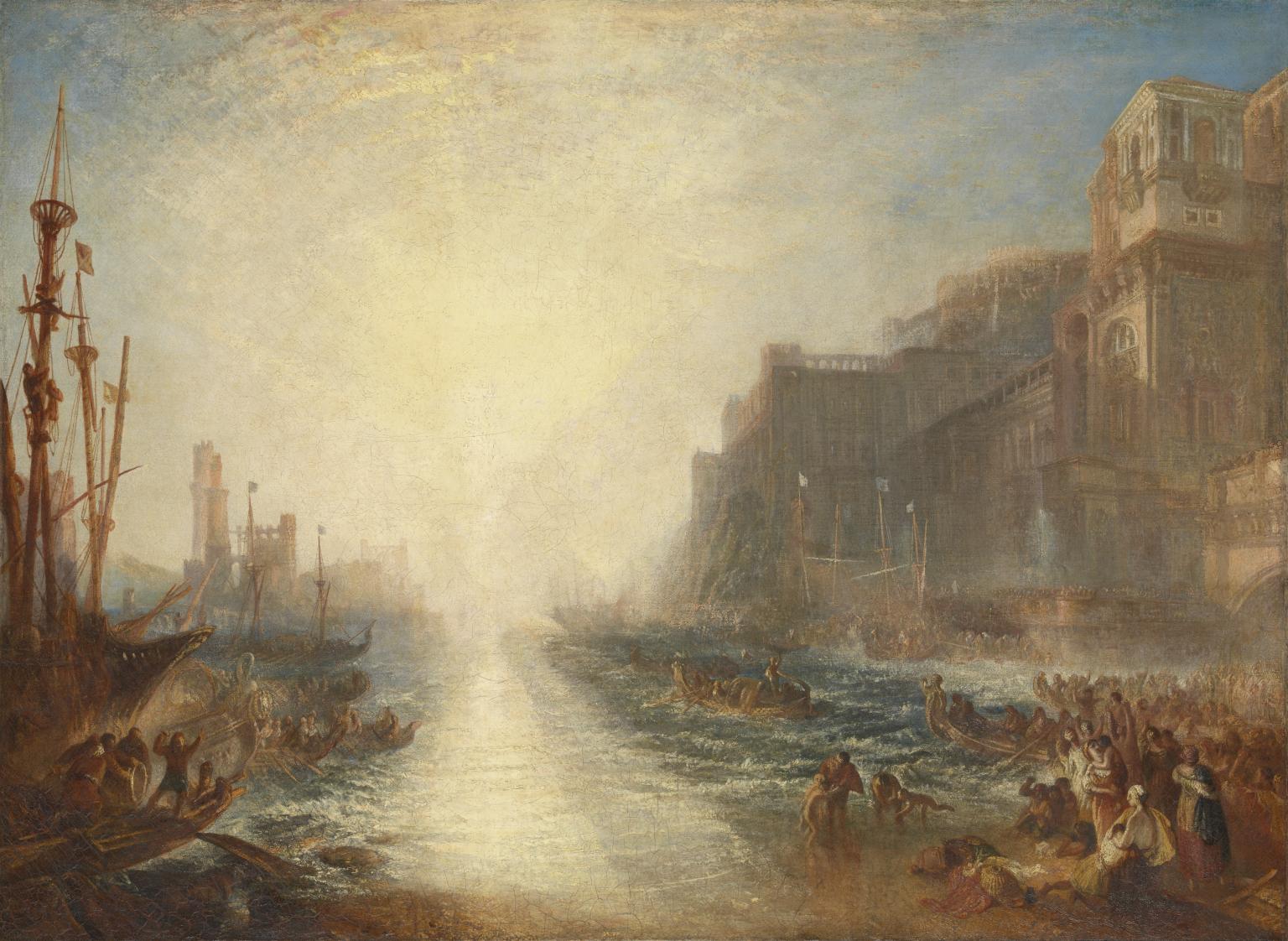
Joseph Mallord William Turner, Regulus 1828, reworked 1837
Turner painted and exhibited this during his three-month stay in Rome in 1828. Its dazzling effect is deliberate. Regulus was a Roman leader who was captured by the Carthaginians. His eyelids were cut off, leaving him blinded by the sun. Regulus may be the figure in white at the top of the stairs on the right-hand side. When he showed this painting in London in 1837 Turner was seen making last-minute changes. His palette apparently contained nothing but a ‘huge lump’ of white. As well as exaggerating the blazing sunlight, he may have also been covering damage the painting had suffered in transit back from Italy.
Gallery label, October 2023
9/9
artworks in Turner Exhibited: Ambition and Reputation
Art in this room
Joseph Mallord William Turner
The Dogana, San Giorgio, Citella, from the Steps of the Europa
exhibited 1842
Joseph Mallord William Turner
The Decline of the Carthaginian Empire ...
exhibited 1817
Joseph Mallord William Turner
Rome, from the Vatican. Raffaelle, Accompanied by La Fornarina, Preparing his Pictures for the Decoration of the Loggia
exhibited 1820
Joseph Mallord William Turner
Castle in an Alpine Valley, called ‘Heidelberg’
c.1844–5
Joseph Mallord William Turner
Ancient Rome; Agrippina Landing with the Ashes of Germanicus
exhibited 1839
Joseph Mallord William Turner
Venice, the Bridge of Sighs
exhibited 1840
You've viewed 6/9 artworks
You've viewed 9/9 artworks
