Artist biography
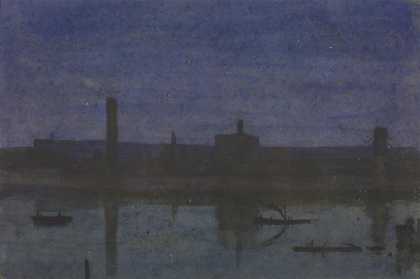
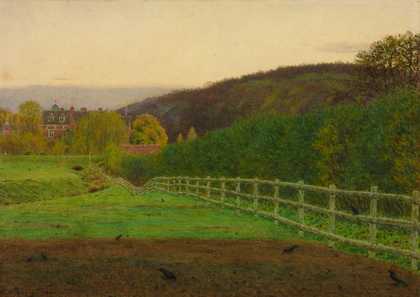
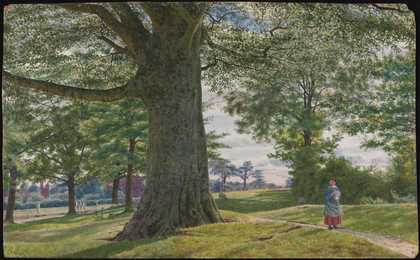
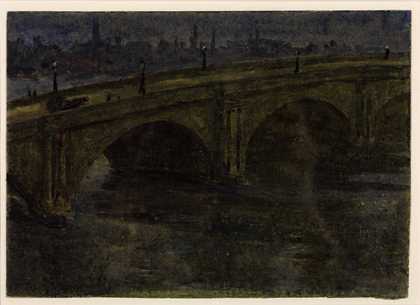
Towards the end of the 1850s Boyce adopted a technique of minute detail and bright colour; various watercolours of this period, are among the most intense and objective of all Pre-Raphaelite landscapes. Boyce abhorred conventional compositions and picturesque detail; he sought viewpoints from which the landscape and buildings might be seen in intriguing conjunction. Boyce ranged England in search of subjects. In the course of a peripatetic career he frequently visited France and Italy, and in 1861–2 he travelled to Egypt.
In 1868 Boyce commissioned Philip Webb to build a house in Chelsea: West House was completed in 1870, and Boyce lived there until the end of his life. He filled the house with an important collection of paintings; he owned many works by Rossetti, which he had commissioned.
As he was of independent means Boyce followed his artistic inclinations without being concerned whether his works would find a ready market. Even if his professional status was uncertain, he was committed to painting and exhibited regularly: at the Royal Academy (1853–61) and in 1857 at the exhibition of Pre-Raphaelite pictures held at Russell Place, London.
Bibliography
A. E. Street: ‘George Price Boyce, RWS', Archit. Rev. [London], v (1899), pp. 151–60
R. Davies, ed.: ‘Extracts from Boyce's Diaries, 1851–75', Old Wtrcol. Soc. Club, xix (1941), pp. 1–71
V. Surtees, ed.: The Diaries of George Price Boyce (Norwich, 1980) [annotated rev. of the diaries with a biog. intro.]
P. Gerrish Nunn: ‘Case Histories: Joanna Mary Boyce', Victorian Women Artists (London, 1987), pp. 146–58
George Price Boyce (exh. cat. by C. Newall and J. Egerton, London, Tate, 1987)
CHRISTOPHER NEWALL
Article provided by Grove Art Online www.groveart.com
Copyright material reproduced courtesy of Oxford University Press, New York