Artist biography
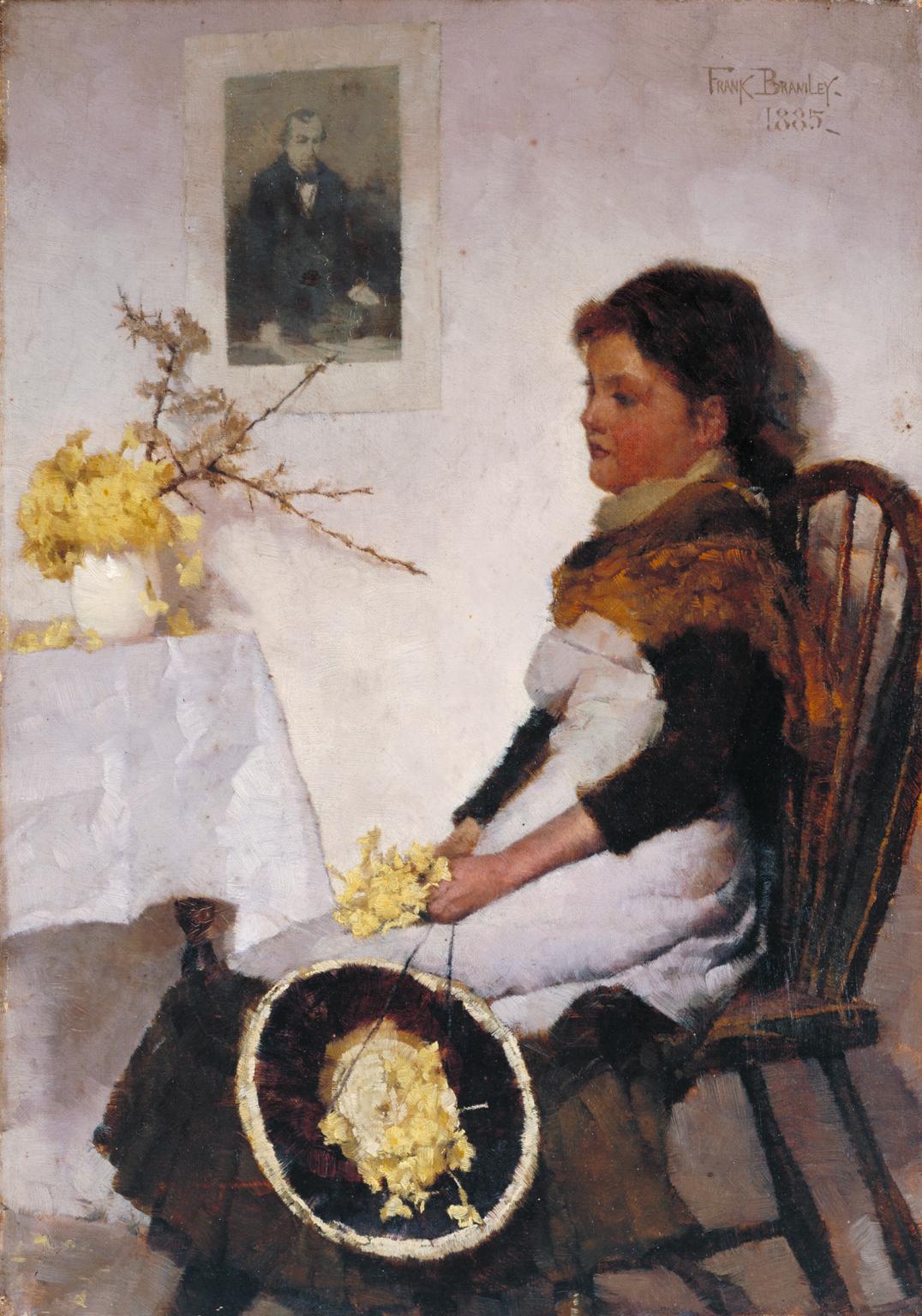
Like Garstin and Hall, Bramley tried to balance his own aesthetic concerns with an emotional and narrative content that would appeal to the general public. A Hopeless Dawn (1888; London, Tate; see England, fig. 21) successfully combined formal strengths with the dramatic and emotional power that Domino lacked. It was purchased by the Chantrey Bequest trustees and established Bramley's reputation. In the early 1890s his paint became brighter, thicker and looser. His subject-range narrowed to portraits, rural genre paintings – often symbolic and quiet scenes of the elderly reflecting on their past. Bramley regularly exhibited at the Royal Academy from 1884 to 1912. He was made an ARA in 1894 and an RA in 1911. He settled in Grasmere, Westmorland (now Cumbria), in 1900.
Bibliography
C. Hiatt: ‘Mr Frank Bramley, ARA, and his Work', Mag. A. (1903), pp. 54–9
Artists of the Newlyn School, 1880–1900 (exh. cat. by C. Fox and F. Greenacre, Newlyn, Orion Gals, 1979), pp. 162–71
Painting in Newlyn, 1880–1930 (exh. cat. by C. Fox and F. Greenacre, London, Barbican A.G., 1985)
B. Cogger Rezelman: ‘Frank Bramley's Primrose Day: A Disraeli Tribute and Artistic Gamble', Vict. Rev., xvii/1 (1991), pp. 51–77
BETSY COGGER REZELMAN
Article provided by Grove Art Online www.groveart.com
Copyright material reproduced courtesy of Oxford University Press, New York


